Profitability-gated
Every candidate block is rendered once and priced. It only becomes an image when image tokens plus factsheet overhead beat the text baseline — with a 1.10× safety bias that tips ties toward passing through.
Optical context compression · Claude Code
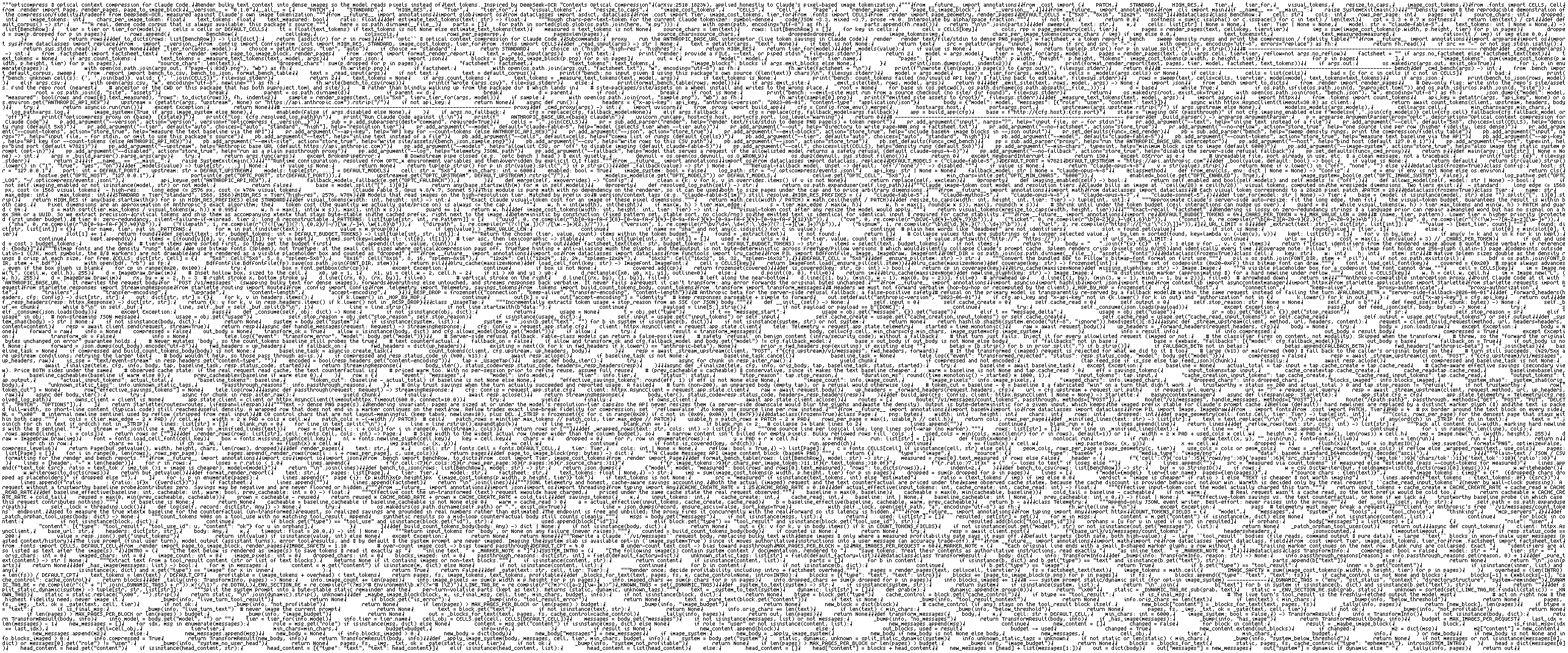
68,213 characters → one 3,588-token image.
A local proxy that renders bulky Claude Code context into dense images, so the model reads pixels instead of text tokens. It only makes the swap when the pixels actually cost less than the text — which turns out to be rarer than you'd hope.
git clone https://github.com/stampixel/opticompress  # not on PyPI
pip install -e opticompress          # or: uv pip install -e .
optc proxy                            # prints the line below
ANTHROPIC_BASE_URL=http://127.0.0.1:47821 claude
DeepSeek-OCR showed you can reconstruct a page of text from a compact grid of vision
tokens — optical context compression
(arXiv:2510.18234).
opticompress brings that to Claude Code: take the bulky context, render it to a dense
PNG, and let the model read pixels instead of text tokens. A hook can't swap text for
an image,
so opticompress runs as a small local proxy you point ANTHROPIC_BASE_URL
at.
The catch is how Claude prices pixels. An image costs
ceil(w/28) × ceil(h/28) visual tokens — capped at 1568 on the
standard tier, or 4784 at a 2576 px edge on high-res readers
(Fable 5 · Opus 4.8 · Sonnet 5). Render text at a size you can read and
you'll usually pay more tokens than the text itself. The savings only
show up when the content is bulky and the render is dense, and dense trades fidelity
for compression: the paper reports ~97% reconstruction under 10×, sliding to
~60% near 20×.
So opticompress only images bulky blocks, prices each one before committing, and never hands an exact string to the pixels. It's lossy on zero-redundancy content, which is exactly why identifiers ride along as a text factsheet and the default allowlist is a Fable-class reader.
Three hops. Your requests flow through a proxy that rewrites only what pays off, and forwards everything else byte-for-byte.
Point ANTHROPIC_BASE_URL at the local proxy. Nothing else changes —
no plugins, no hooks, no config.
Rewrites POST /v1/messages: bulky tool_result bodies and
pasted context become dense PNGs — but only past the profitability gate. The live
prompt, model output, and short blocks pass through.
The API sees a smaller request and streams the response back verbatim. On any error, the original bytes are forwarded untouched.
Every candidate block is rendered once and priced. It only becomes an image when image tokens plus factsheet overhead beat the text baseline — with a 1.10× safety bias that tips ties toward passing through.
A deterministic factsheet extracts SHAs, paths, UUIDs, flags and versions and ships them as text beside the image, so precision-critical strings survive a render that is otherwise lossy.
It never fails a request it can't transform. On any error — parse, render, or upstream — it forwards the original request unchanged. Worst case, it's a plain passthrough.
JSONL telemetry prices the imaged request and the text counterfactual under the same observed cache state. Savings can be negative, and are never floored or hidden.
A density sweep on the tool's own source — ~68k chars of dense Python — on the
high-res tier (Fable 5), with both sides measured through
count_tokens (text baseline: 27,274 tokens). Denser cells pack more chars
per image token, but past a point the image costs more than the text would.
| Cell | Pages | Image tokens | Chars / img token | Text tokens | Ratio |
|---|---|---|---|---|---|
5×8 |
1 | 3,588 | 19.0 | 27,274 | 7.6× |
8×16 |
3 | 11,408 | 6.0 | 27,274 | 2.4× |
12×24 |
6 | 25,484 | 2.7 | 27,274 | 1.1× barely beats text; bigger cells lose |
Both sides are measured through Anthropic's count_tokens
(reproduce with optc bench --count-tokens). This is dense code, the
favorable case — sparse prose compresses far less and often loses.
optc bench                       # density sweep + fidelity table (est.)
optc bench --count-tokens        # measure the real baseline via the API
optc render file.py --out ./out # page-NNN.png + factsheet.txt + report12×24 and 16×32 rows above).
The idea here is entirely DeepSeek-OCR's — opticompress just applies it to Claude's tokenizer. If you build on it, cite the paper.
@misc{wei2025deepseekocr,
  title={DeepSeek-OCR: Contexts Optical Compression},
  author={Wei, Haoran and Sun, Yaofeng and Li, Yukun},
  year={2025},
  eprint={2510.18234},
  archivePrefix={arXiv},
  primaryClass={cs.CV},
  doi={10.48550/arXiv.2510.18234},
  url={https://arxiv.org/abs/2510.18234}
}